Aether Manifesto · September 2026
The year is 2030. It is 2:17 AM.
A 62-year-old man in a Pune hospital is asleep. So is his doctor. A new blood test has just come back.
His healthcare agent reads the report. Creatinine: 1.8.
The agent traverses his Aether health graph. His creatinine has been rising for three years. Another hospital changed one of his medicines nine months ago. Six months ago, a physician noted swelling in his legs. Two months ago, his daughter sent an older report over WhatsApp that showed another small deterioration.
The agent now sees something the new report cannot show on its own: this may be a worsening trajectory, not a single abnormal result.
It prepares an action plan for his doctor: repeat renal function and electrolytes, review his medications in light of the decline, check for protein in the urine, and consider a nephrology referral. It pulls the previous results that support its reasoning, drafts the referral note and prepares a message for the patient. Nothing clinical is executed without the doctor's approval.
His doctor opens her morning briefing. Three patients need attention. He is at the top. She sees the three-year trajectory, the medication change, the earlier symptom, the evidence behind the agent's reasoning and the proposed next steps. She edits one item, approves the plan and moves on.
She has not spent twenty minutes reconstructing his history before she can begin thinking about what to do next. The agent has already done that reasoning, between 2:17 AM and 2:19 AM, while she was asleep. It could do that because the patient's health graph had already been building for years.
For most patients today, that graph does not exist. Their reports, prescriptions, scans, consultations and hospital visits remain scattered across documents, institutions and systems. We have records of individual moments, but very little that continuously represents the person across time.
Health is a movie.
By 2030, we will have extraordinarily capable healthcare agents. But those agents will need something today's healthcare systems were never designed to create: a continuous memory of the patient. That memory cannot simply be switched on in 2030. It has to start being built now.
In 2017, I learnt what happens when it isn't.
2017
When the history was missing
My mother became seriously ill that year. As her health deteriorated, she saw doctors across different hospitals and countries. Her care generated an enormous amount of information, but nobody had the complete history.
I began collecting her medical reports myself and entering the results into a spreadsheet so that I could understand what was happening over time. Each report made sense in isolation. Once I put the history together, patterns became visible that were difficult to see in any single document, including two comorbidities that emerged only when the information was viewed longitudinally.
We discovered that my mother had cancer only a day before she passed away.
What stayed with me was not that there was too little information about her. There was plenty. The problem was that nobody could see enough of it together, across time, and in the context of everything else that was happening to her.
It lacked memory and context.
For years, that problem remained. What changed was what medicine and technology began making possible.
Medicine is starting to look very different
Personalized medicine is becoming real
Sid Sijbrandij, the co-founder of GitLab, has approached his osteosarcoma at an extraordinary level of personalization. When his cancer returned and standard care ran out of options, he built his care around information: more than 1,000 pages of health notes, raw data from every lab, scan and sequencing result, and maximal diagnostics used to guide a personalized ladder of treatments.
Today, he is in remission, and in 2026 Houston Methodist developed a personalized mRNA vaccine targeting proteins unique to his tumour to help prevent it from returning.
Not a bespoke cancer vaccine for everyone tomorrow, but medicine that increasingly understands the individual rather than only the disease: their history, biology, previous treatments, response and trajectory.
At the same time, our ability to measure the human body is exploding.Midjourney is developing what it calls Ultrasonic CT, a whole-body ultrasound system using sound and water. Its stated ambition is eventually to scan a body in around 60 seconds and, by 2031, deploy more than 50,000 scanners capable of a billion scans a month. Those are Midjourney's targets, not demonstrated clinical scale, and the diagnostic potential still requires validation and regulatory approval. But whether or not its timetable holds, the direction is striking: the amount of information we can generate about the human body is going to increase dramatically.
Add laboratory tests, genomics, pathology, wearables, prescriptions, clinical conversations, vitals and entirely new forms of measurement that will emerge over the next decade. Medicine may soon have the opposite problem from the one it has historically faced. Instead of knowing too little about us, it may generate far more information about each person than any doctor, hospital or human being could possibly absorb.
But more information does not automatically create more understanding. A scan is still one scan. A laboratory report is still one moment in time. A brilliant doctor looking at one report is still looking at one report. A brilliant AI has the same problem.
We are becoming extraordinarily good at measuring people. AI is becoming extraordinarily good at reasoning. Medicine itself is becoming increasingly personalized.
A different base
The Patient, Over Time
Today's healthcare systems are largely built around encounters, documents and institutions. We are now putting better search, better documentation, copilots and increasingly capable agents on top of them. All of those things will improve healthcare, but the underlying base remains largely unchanged.
Aether starts somewhere else: with the patient, over time.
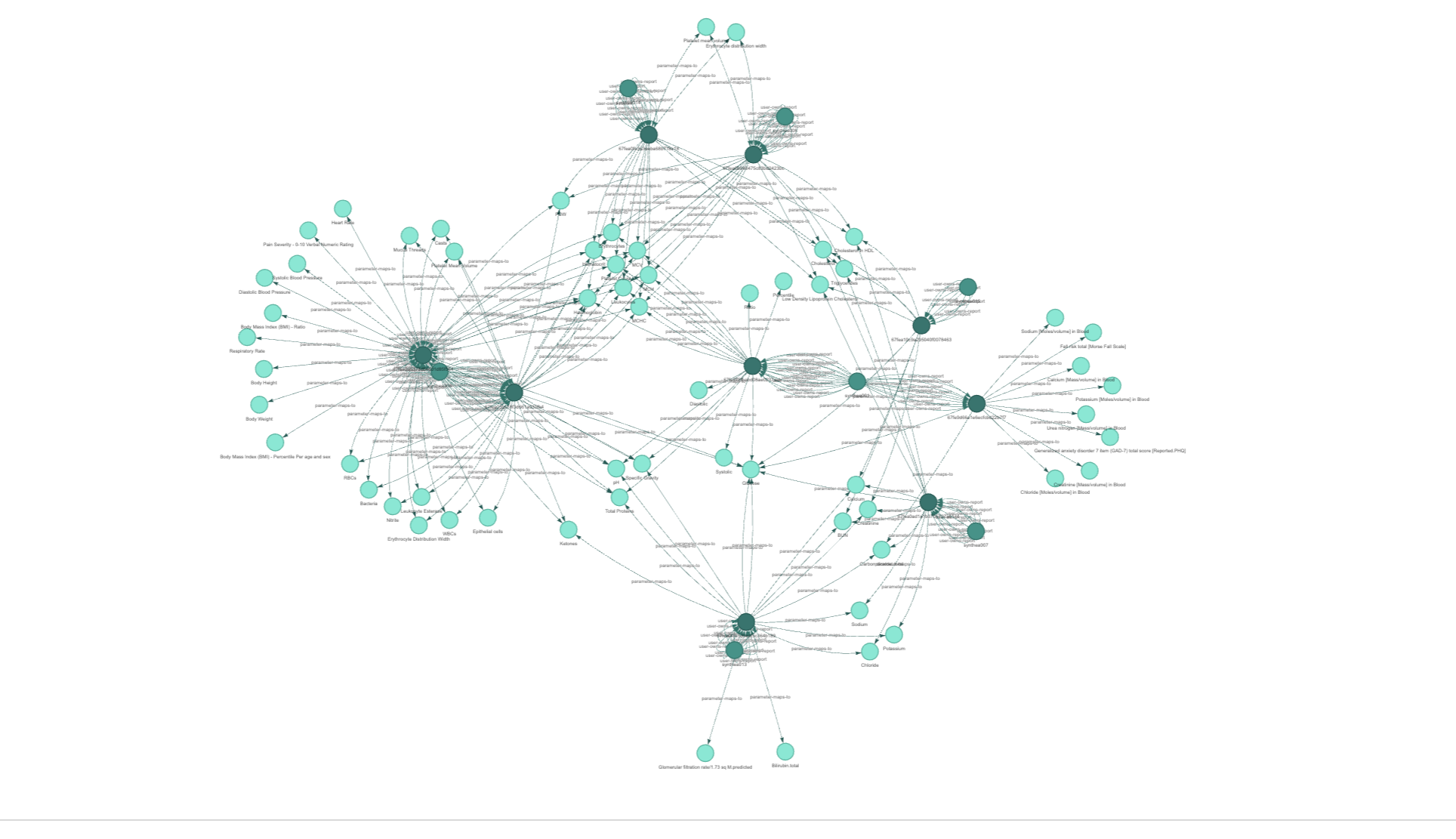
A report is not the record. It is one event in a continuing history. The same is true of a prescription, an image, a consultation, a diagnosis or a treatment. Connected across time, those events become a health graph: not simply what happened, but what changed, what came before it and what happened next.
The way information enters that graph will keep changing. Today it can come from a clinical conversation, a PDF, a scan, WhatsApp, imaging or an existing hospital system. Tomorrow there will be channels we have not imagined. The important thing is not the channel. It is that those fragments become part of the same patient over time.
As healthcare becomes agentic, that history gives the agent someone to understand. As medicine becomes personalized, it gives the doctor an individual's trajectory rather than today's snapshot. And once the same structure exists across millions of people, it creates an entirely new layer of intelligence.
The graph compounds
The health graph is.
Models will keep getting better. Agents will become easier to build. Interfaces will change. What compounds is the longitudinal history underneath them. Every new report, treatment, encounter and outcome adds context to what came before it, and makes the graph more useful to whatever doctor, institution or AI eventually sits on top of it.
The patient's history cannot.
That is why the graph has to start being built now.
From one person to millions
What the graph becomes at scale
For one person, the graph creates memory. Over years, that memory becomes context. Across thousands of people, patterns begin to appear: conditions that travel together, trajectories that precede deterioration, and patients who initially look similar but respond very differently to treatment.
Among people whose histories looked like this patient's history, what happened next?
Who deteriorated? Who stabilised? Which treatments worked better for which kinds of patients?What actually happened to a million patients after this treatment?
Not inside a controlled trial, but across multiple conditions, changing medications, different hospitals and years of real life.The same longitudinal graph can help personalize the next decision for one person and reveal what actually happened across millions.
Why India
Healthcare operates at enormous scale, but much of its information is still created through conversations, paper, PDFs, scans and disconnected systems. At the same time, ABDM and related initiatives are creating digital rails through which healthcare information can increasingly move.
India is not the ceiling of Aether's ambition. It is where I believe we have an unusual opportunity to build one of the world's deepest longitudinal health graphs.
It has already started. Since late 2025, more than 10,000 patients have entered Aether and the platform has structured more than 240,000 clinical parameters into longitudinal patient records. Aether is live across two clinical deployments, with a nine-hospital network in discussion around a broader deployment, and has received support from Tyler Cowen's Emergent Ventures at George Mason University.
Those numbers are still tiny compared with where this can go. But they mean the graph is no longer theoretical. Real patient histories are already beginning to accumulate through real healthcare workflows.
Back to 2030
Go back to Pune at 2:17 AM.
The healthcare agent can reason across years of history in two minutes because those years of history are already there.
What I tried to construct manually for my mother in a spreadsheet was a primitive version of this for one person. Sid's experience shows how far personalized medicine can go when extraordinary information and technology are assembled around an individual. Midjourney gives us a glimpse, even if its specific roadmap proves ambitious, of how dramatically the information generated around each of us may grow.
The opportunity is to bring those worlds together, not only for exceptional patients with extraordinary resources, but for millions of ordinary people.
The systems underneath it should not either.