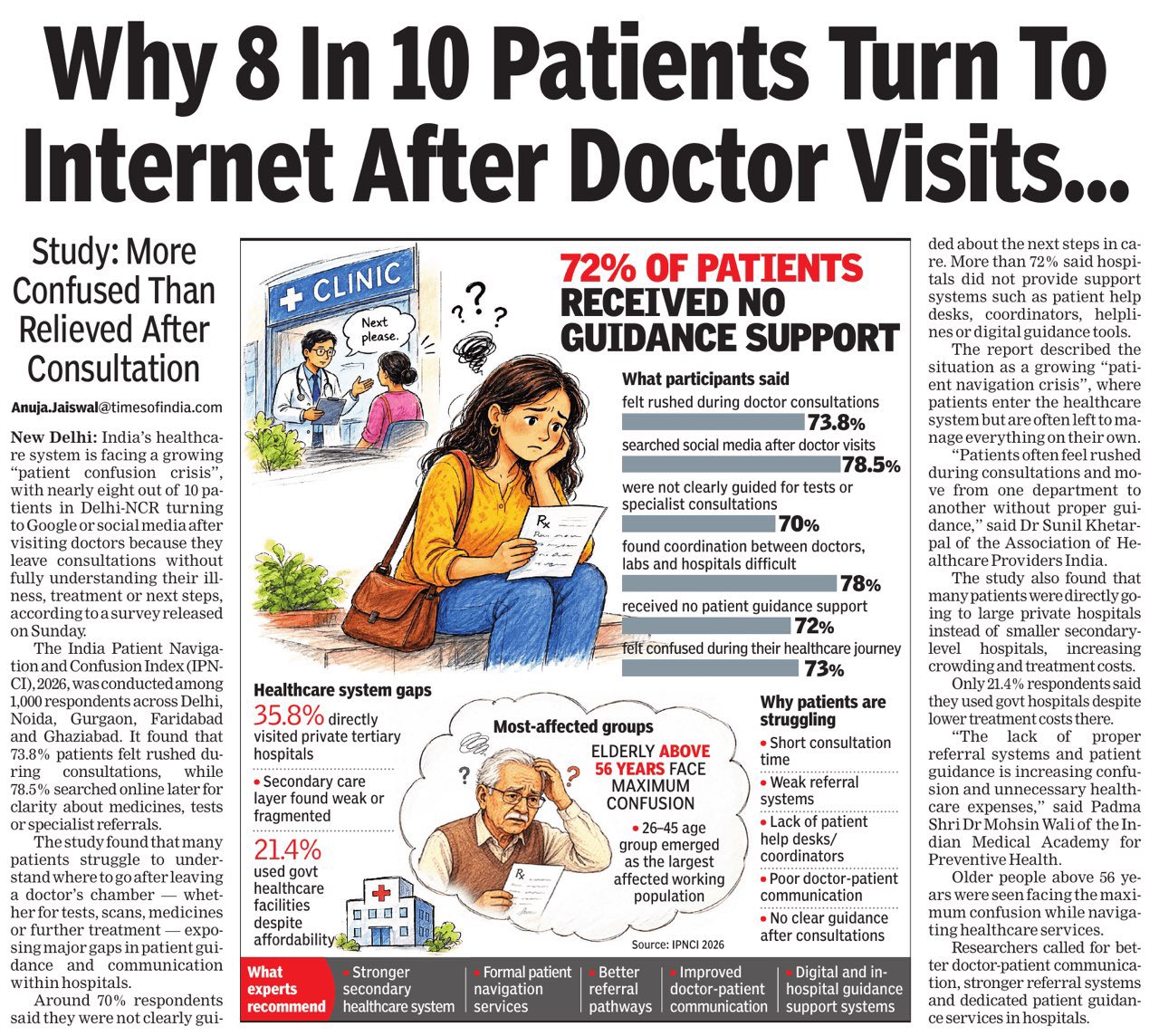
A recent article by Anuja Jaiswal in The Times of India caught my attention. Reporting on the India Patient Navigation and Confusion Index 2026, she highlighted a striking finding: nearly 8 in 10 patients in Delhi-NCR search online after visiting a doctor.
The numbers themselves are revealing. According to the report, 73.8% of patients felt rushed during consultations, while 78.5% searched online afterward for clarity about their illness, medicines, tests, or next steps. More than 70% reported difficulty coordinating between doctors, laboratories, hospitals, and specialists.
Anuja also shared the findings on X, framing it as a growing patient confusion crisis. That is a useful phrase. But I think there is an even deeper issue underneath it.
At first glance, the conclusion seems obvious. Patients are confused because they need better information.
I am not sure that is the real problem.
Patients do not leave consultations empty-handed
Patients do not usually leave a consultation with nothing. They leave with information. A diagnosis, a prescription, perhaps a referral to another specialist, and often a recommendation for additional tests. In many cases, they leave with more information than ever before.
The problem is not the absence of information.
The problem is the absence of context.
A diagnosis only makes sense in relation to a patient's history. A laboratory result only becomes meaningful when viewed alongside previous results. A prescription raises questions that extend beyond the medication itself: Why this drug? Why now? What happens if it does not work? How does it connect to everything that came before?
Those questions are rarely answered by a single consultation, a single report, or a single document. They require continuity. They require the ability to see the story rather than the fragments.
Healthcare generates information. It does not always connect it.
The modern healthcare system has become extraordinarily good at generating data. Every encounter produces another note, another test result, another image, another prescription, another discharge summary, another referral.
But very little of this information naturally arrives as a coherent story for the patient.
The cardiologist understands one chapter. The endocrinologist understands another. The laboratory sees a different piece altogether. The hospital may hold yet another part of the record. Each participant contributes something valuable, but nobody is always responsible for assembling the complete narrative.
The patient becomes the integration layer.
That is exhausting. Patients carry folders between appointments. They repeat the same medical history over and over again. They forward reports on WhatsApp. They search through lab portals. They try to remember the name of a medicine prescribed six months ago. And after all of this, when something still does not make sense, they turn to Google.
Google is becoming the fallback health record
We often assume patients search online because they do not trust doctors. Sometimes that may be true. But I suspect a large part of the behavior is simpler and more understandable.
Patients are trying to reconstruct the story.
Google becomes the place where all their questions can exist at once. What does this diagnosis mean? Is this medication safe with another one I am already taking? Why did this test come back abnormal? Should I see another specialist? Is this connected to something that happened last year?
The healthcare system generated the pieces. The patient is left to assemble the puzzle.
That is why the phrase "patient confusion" feels slightly incomplete. Confusion is the symptom. Fragmentation is the system condition underneath it.
Patients experience healthcare as a journey
Healthcare systems are organized around encounters. Patients experience healthcare as a journey.
A hospital visit is one moment. A lab report is one moment. A prescription is one moment. A specialist referral is one moment. But the patient does not live in moments. The patient lives across time, carrying symptoms, anxieties, previous results, medication changes, family history, and unanswered questions from one encounter to the next.
This is especially true in chronic disease, where the relevant story may unfold over years. A single HbA1c result matters. But a five-year HbA1c trend matters more. A single creatinine result matters. But kidney function over time matters more. A single prescription matters. But whether medications changed, failed, or were stopped matters more.
When healthcare loses continuity, patients feel that loss directly. They may not describe it using words like interoperability, longitudinal records, or clinical context. They simply feel lost.
This is where Aether fits
At Aether, this is the problem we keep coming back to. Patients do not need another place to store documents. They need a way to understand how their health story fits together.
That means turning scattered reports, prescriptions, scans, clinical notes, and vitals into a longitudinal view that can be understood, shared, and updated over time. It means helping patients carry context forward instead of rebuilding it from scratch at every consultation.
It also means helping doctors. A patient who arrives with a clear health timeline, structured reports, medication history, and prior context is easier to help than a patient carrying a pile of disconnected PDFs.
This is not about replacing doctors with AI. It is about reducing the burden on both sides of the consultation.
Patients are not searching for information. They are searching for the story.
The Times of India report describes this as a patient confusion crisis. I think it reveals something deeper.
Healthcare does not have an information problem. It has a context problem.
And patients are paying the price.