OpenAI has made two announcements over the past week that I found particularly interesting for healthcare. The first connects ChatGPT for Healthcare directly to Epic, allowing a clinician to ask questions across notes, lab results, medications and other information already sitting inside the patient's record. The second is GPT-6 Astra, which can reason across much larger amounts of information and work more effectively across software and multi-step tasks.
At first glance, the conclusion seems fairly obvious. AI is moving deeper into the EHR, and increasingly capable models will become part of the software doctors already use. I think that is probably true, but putting the two announcements together also points to another problem.
The model can only understand what it can see
Many of the questions OpenAI describes are really questions about a patient's history. What has changed since the last visit? Did another doctor change a medication? Are any recent lab results important? Has something been left unresolved?
To answer these properly, the model needs more than the latest consultation or report. It needs enough of the patient's history to understand what has changed over time, and as these models get better, I think the completeness of that history becomes even more important.
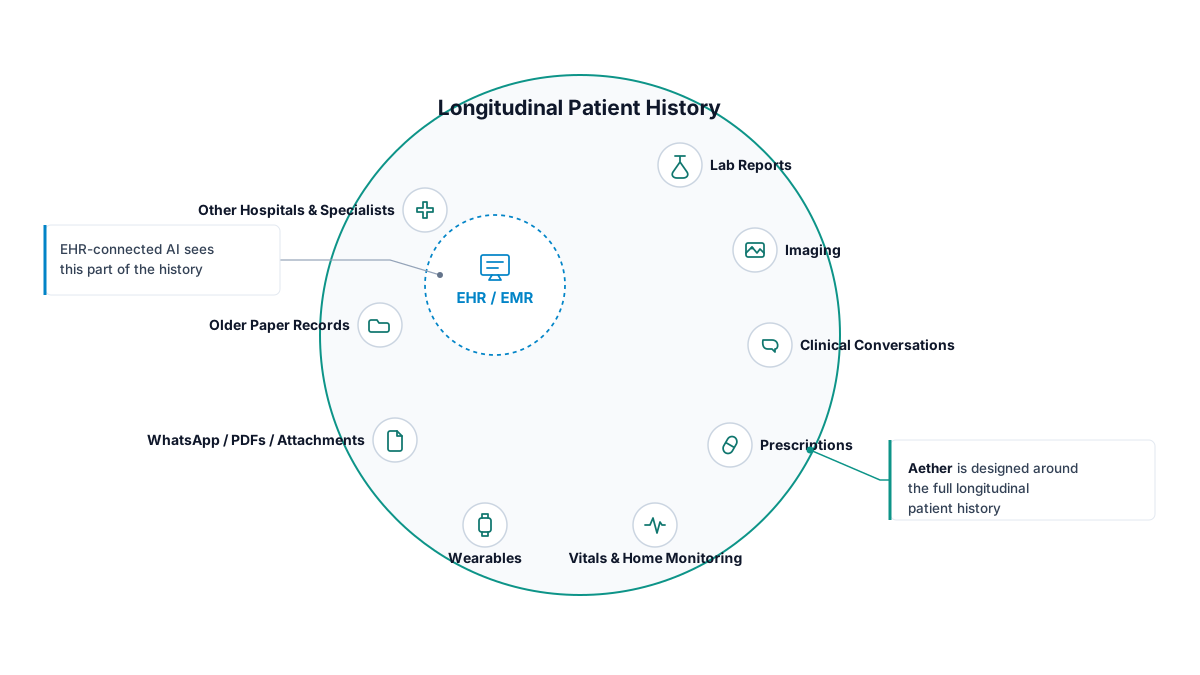
An EHR can contain a very rich record of what happened to someone inside a hospital or health system. But that same person may have visited another hospital, had blood tests at a different laboratory, seen a specialist independently, undergone imaging somewhere else, received a paper prescription, or have years of older records sitting at home. All of that belongs to the same person's health history, which means the EHR may be a very important part of the patient's context, but it may still only be one part of it.
In India, the problem starts even earlier
In India, much of this information is not simply spread across different digital systems. Quite often, it has never entered a structured digital system at all, and instead sits inside lab PDFs, paper prescriptions, scans, WhatsApp messages, email attachments, or physical folders that patients carry from one doctor to another.
Some hospitals are highly digitised, while many smaller clinics still work largely through paper and conversation. The result is that a patient can have years of medical history without any doctor, hospital or software system having a continuous view of what actually happened.
ABDM is building extremely important infrastructure to help healthcare information move between patients and providers. But I think there is a step before interoperability that gets less attention, because before useful health information can move, it has to be captured and structured in the first place.
This is why I do not think India's healthcare opportunity is simply to build more, or even better, EHRs. A large part of the longitudinal digital history that future healthcare AI will depend on still has to be created.
Better AI makes the history more valuable
Another thing about the Astra news is how quickly the models are moving. Today's most capable model will almost certainly not be the most capable model a few years from now, and hospitals will increasingly have access to OpenAI, Google, Anthropic, specialist medical models and systems that have not yet been built.
That means access to powerful intelligence may become easier over time. Patient history is different, because ten years of clinical context cannot suddenly be recreated when a better model arrives.
Every consultation, lab result, prescription, scan, diagnosis and vital adds another piece to what is known about the patient. A glucose result has value on its own, but five years of glucose results alongside HbA1c, weight, medications and diagnoses tell a much richer story. A prescription becomes more meaningful when you can see what was happening before it was prescribed and what happened afterwards.
The model looking at that history can keep changing, while the history itself keeps accumulating. I think that difference is going to matter a great deal as healthcare AI becomes more capable.
Healthcare is not going to have one system
None of this makes the EHR less important. Hospitals need EHRs, laboratories need laboratory systems, imaging centres need imaging systems, and doctors need software that fits the way they actually work. I also do not think healthcare will ever neatly converge into one application.
The more interesting problem is what happens to the patient as they move between all of them. A person's medical history should not begin again every time they enter a different hospital. The institution is part of the context around the patient, but the patient is the one thing that remains continuous.
That is the problem we have been working on at Aether. Reports, prescriptions, imaging, vitals and clinical encounters may arrive through completely different channels, but they can still become part of the same longitudinal health graph. The goal is not to replace the systems healthcare already uses, but to make the patient's history continuous around them.
Healthcare still needs memory
OpenAI connecting ChatGPT to Epic is an important development, and Astra makes the direction even more interesting. The intelligence is improving very quickly, and it is becoming increasingly capable of working across complicated information and clinical workflows.
What I understand from these announcements is not simply that AI will now live inside the EHR, but that the better the intelligence becomes, the more important the information underneath it becomes. Healthcare already creates an enormous amount of information about each of us, but much of it gets left behind in different institutions, formats and moments in time.
If AI is eventually going to understand the patient rather than only the latest encounter, we will need to solve that problem as well. The intelligence is arriving very quickly, but it will still only be as useful as the history it can see.